Thursday, December 14, 2017

Hamilton

Ah, Hamilton, the show everyone's been raving about, and one that I managed to see without risk of missing out on if I didn't go pronto.  (Although that's really because of a lucky accident; a friend of a friend had tickets and could no longer make it, so my husband snatched them for us.  Lucky me!)

A few takeaways:

  1. Yes, it was as amazing as advertised and totally lived up to the hype.
  2. However, I'll admit it was not love at first sight, and it took me halfway through the first act before I fell into the groove.
  3. A big part of the appeal is how unique Hamilton is from every other show I've seen.  It may be an old story, but it's put together in a very modern way...part of which is hip hop. That's also why it took me a while to get into it; I'm not a big hip hop person, and so many lyrics were rapped/sung very quickly, which requires great concentration and hearing to be able to catch what they're saying/singing.  I definitely missed a lot of the lyrics.
    • Advice -- listen to the soundtrack before going.
  4. I would love to go back and see it again.  There were so many witty moments that I'm sure would be better appreciated the second or third or nth time around (and not just because I missed some lyrics either).
  5. Because so much of it is rapped and not traditionally melodic, I don't have as many songs stuck in my head like I normally do.  The exception is the funny King George songs.  Not a bad thing; just an observation.  And btw, I quite liked the sarcastic, ironic, British humor in those King George parts.
  6. And finally, what a great refresher on history in a fun way!

Miss Saigon

I seem to have developed a bad habit of procrastinating until the last minute to see Broadway shows, barely squeezing them in before they close.  That was the case for Les Mis, American in Paris, and now again for Miss Saigon.  Well, better late than never.

Unlike many of the other musicals I've seen, I was not too familiar with either the music or the story of Miss Saigon initially -- I never played any of the music in high school orchestra, and the story is not widely referenced or known in pop culture.  However, a good friend of mine walked down the aisle to an instrumental version of "Sun and Moon" a few years ago, and I immediately fell in love.  I became even more obsessed when I learned that Queen Lea Salonga was the original Kim.

Here, just listen:


You're welcome.

Anyway, long story short, I was super ecstatic when about a year ago, I saw signs in Times Square announcing the return of Miss Saigon to Broadway.  I foolishly thought I'd have a lot of time to go see it; fast forward a year later...I found out the show's ending in January 2018 and then scrambled to get tickets.

Miss Saigon is one of those shows where there aren't that many songs (rather, many songs are based on just a few of the same melodies/themes), but they're all beautiful and lyrical and touching and emotionally charged, whether it's a sweet love song or an angry fight.  I enjoyed the show just for the experience of listening to the music and didn't even care that the current cast may not all be the strongest singers (then again, who can compare to Lea?).  Some of my friends felt that there wasn't much plot or character development in the first act (there isn't; you just jump in and assume the love story is a given), but the second act makes up for some of the plot holes, and I think you still go on an emotional journey with the characters if you just accept the plot line.

Overall, I'm so glad I managed to see it.  For those in NYC, you have about another month before the show ends here, and then it's going on a national tour for those of you in the rest of the U.S.

Tuesday, May 16, 2017

Current Exhibits at The Met -- the Old, the New, the In Between

The Met always has an expansive collection worth seeing, but two in particular, both currently on display, piqued my interest.  The first is "Age of Empires: Chinese Art of the Qin and Han Dynasties," and the second is "Rei Kawakubo / Comme des Garçons: Art of the In-Between."  To make our lives even easier, they are located right next to each other on the same floor (2nd floor, Tisch Galleries).

Age of Empires: Chinese Art of the Qin and Han Dynasties (221 B.C. - A.D. 220)
At The Met Fifth Avenue, April 3 - July 16, 2017

This exhibit features nearly 170 objects from ancient China, including rare ceramics, sculptures, paintings, and textiles, but perhaps the most exciting (at least to me) are the terracotta warriors.  The Terracotta Army (兵馬俑) is a large collection of unique terracotta sculptures depicting the armies and palace attendants and performers of Qin Shi Huang (秦始皇), the first emperor of China.  These life-sized clay sculptures were created with the intent to be buried with the emperor and to protect him in his afterlife.

The Terracotta Army was discovered in 1974 by workers digging a well outside of Xi'an and is one of the greatest archaeological discoveries in the world.  The workers found thousands of clay soldiers, each with unique facial expressions and positioned according to rank, lined up in trenchlike, underground corridors.  There are soldiers with different types of weaponry as well as horses and chariots -- in a nutshell, it was a replica of Qin's actual army.  There are three main pits with the Terracotta Army, and in other nearby trenches, there are non-military figures, such as court officials, acrobats, and musicians.  Most of the site remains unexcavated, including Qin Shi Huang's actual tomb, as workers soon discovered that the terracotta sculptures lost their color and turned gray after being exposed to the air.

The Met dedicates one room of the Age of Empires exhibit to the terracotta warriors, which include actual items from the site as well as replicas.  It's not quite the same experience as being in the actual trenches in Xi'an, but this is much more geographically friendly and still quite enjoyable.


One other interesting item on exhibit is the burial ensemble of Dou Wan, who was the wife of Prince Liu Sheng of Zhongshan during the Western Han dynasty.  The burial suit is comprised of small jade plaques, each shaped, fitted, and strung together with gold wire.  It represents the completion of a magical transformation of a deceased's body, as the jade suit protects the body and soul, enabling the deceased to attain immortality.


Rei Kawakubo / Comme des Garçons: Art of the In-Between
At The Met Fifth Avenue, May 4 - September 4, 2017

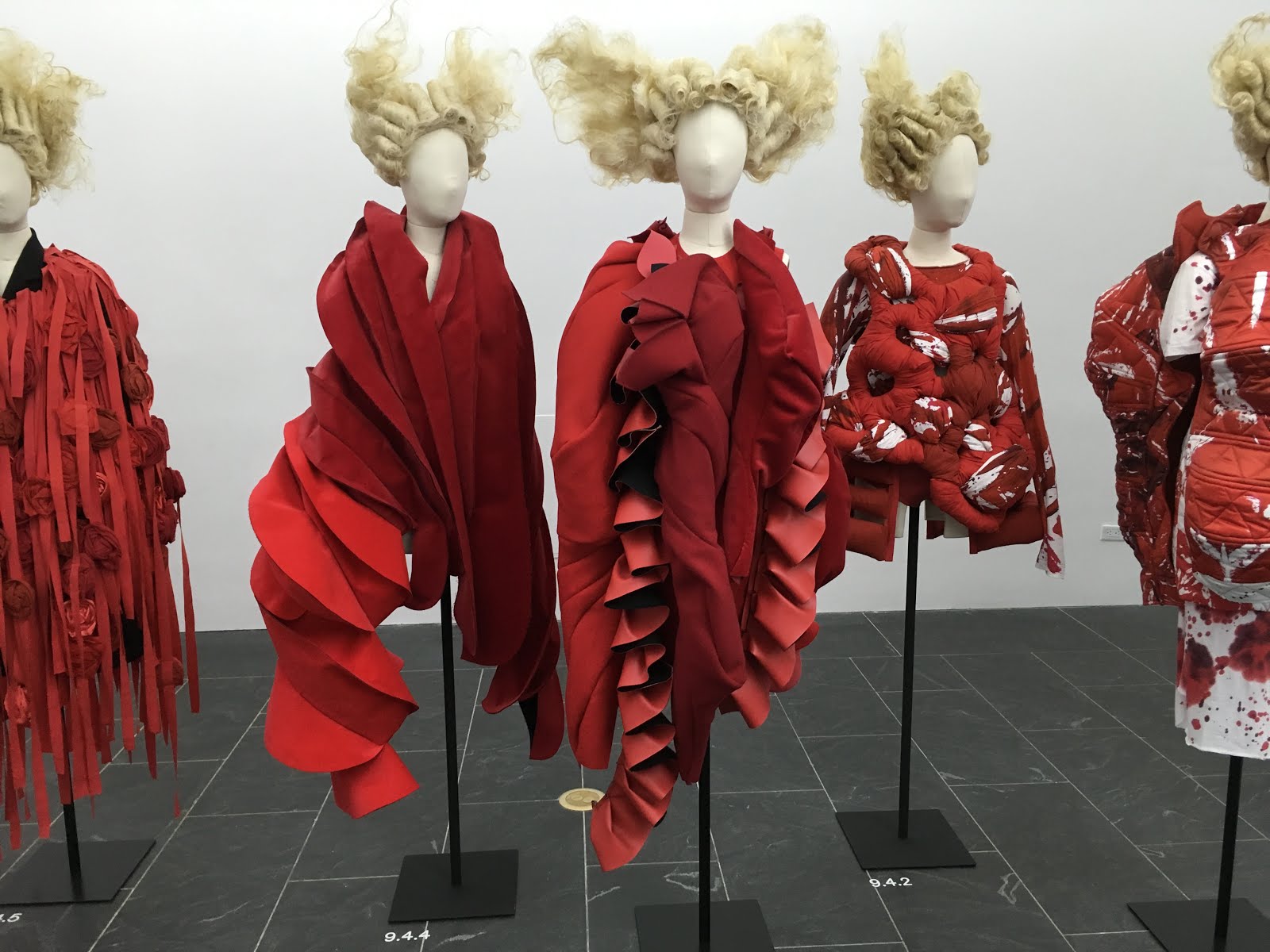
The opposite of ancient is modern...very modern...Kawakubo.  Rei Kawakubo is a Tokyo-based designer known for her avant-garde designs and extremely unconventional (perhaps unwearable) clothing that challenge our notions of beauty, taste, and fashion.  Since founding Comme des Garçons in 1969, Kawakubo has consistently redefined and challenged fashion and aesthetics.  This spring 2017 exhibit is the Costume Institute's first exhibit dedicated to a living designer.

The Art of the In-Between features nine expressions of "in-betweenness" in Kawakubo's collections: Absence/Presence, Design/Not Design, Fashion/Antifashion, Model/Multiple, High/Low, Then/Now, Self/Other, Object/Subject, and Clothes/Not Clothes.  Kawakubo's designs explore and reveal the spaces between these dualities, questioning our arbitrary definitions and offering possibilities for innovation.

But all that said, I'll still be the first to admit that I don't always understand modern art.  The backdrop and explanations certainly help provide more context, and I can appreciate the intent, creativity, and art behind the designs; however, conservative, boring me had a hard time seeing the designs as wearable clothes.  (Would you wear any of these??)  Then again, I feel that way about a lot of runway, couture designs.  I guess that's why I don't work in fashion.


Wednesday, March 22, 2017

Downtown Happenings

I rarely make a trip to FiDi and still don't know my way around down there, despite having lived on Water St. for two semesters during the good ol' college days, but now that I'm there every work day, I'll have to admit there are some pretty cool things happening at Brookfield Place and the Oculus.  And there are so many pretty shops that make me want to drool, except none are open on my way to work, and most seem closed by around 7pm...and who has time to shop during the middle of the day?  *sigh...at least I'm enjoying Hudson Eats so far, but I'm sure I'll just default to the same three lunch places over and over in another week.

Anyway, for those of you who don't live or work downtown, here are a few fun things that you might be interested in checking out.

 1. Ice Skating (sign up for free lessons Sat-Sun 9-9:45am) 
Pay a visit to the rink soon before it goes away, you know, because now it's officially spring (in case you can't tell from the snow...ha).  If you're an early riser, live downtown, and/or really want to cash in on free benefits, sign up for a free skating class too!  Extra perk: the rink seems pretty empty, although I don't know if it gets more crowded on weekends.


 2. Hot Shots Basketball Competition (until Friday, March 24, 11am - 7pm)
Okay, maybe it's not really a competition, but you get to shoot hoops and enter a lottery to win a $250 gift certificate to Brookfield Place.

 3. Dancers Among Us Gallery (until Sunday, May 14, 12-6pm daily)
13 awesome photographs by Jordan  Matter of dancers doing extraordinary things in ordinary, everyday settings.  The best part is there's a story behind each of the photographs -- the inspiration for the shot, the difficult process it took to capture the moment -- as well as a "behind the scenes" video in the gallery to make you really appreciate the art.

He's not levitating...he's just mid-backflip

Rainbow!
That was a random dog...what a naturally talented actor
Mind blown.  They're all "lining up" to donate to Salvation Army.  The lady in the background could not care less though.


 4. "The Water Clouds" by Stella Artois
I've been wondering what people were doing with all those balloons in the Oculus the past couple of days, but now I know -- today is (UN) World Water Day.  As part of this year's campaign, Stella Artois is selling limited edition chalices for $6.50, and each purchase will fund 5 years of clean water for one person in the developing world.


P.S. In case anyone's wondering, I still don't know my way around downtown, but I do know how to get from the subway station to my office via the underground transport hub.  Shops I look at everyday but have not gone in: Grom, Bottega Venetta, Ferragamo, Hermes.  It's probably better this way.

Sunday, January 29, 2017

Rice and Flower -- Cupcake Decorating Class


A dear friend recently discovered a cute handcrafted flowercake boutique called Rice and Flower that offers cake decorating classes, so we signed up and spent five hours today learning how to pipe apple blossoms, hydrangeas, poms, and chrysanthemums.
     

All I can say is, I have a newfound appreciation for pastry chefs who spend hours masterfully crafting their tasty artwork.  My hand was getting sore from all the piping, and sadly, most of my "good" ones were accidents rather than the norm.  Never will I ever complain again about how expensive a decorated cake is, although that said, unless it's some special occasion cake, I think I'd still prioritize taste over looks (I know it's a stereotype that fancy decorated cakes don't taste as good, but stereotypes exist for a reason!  But I shall never discriminate against any cake).

On the subject of taste, though, the class offers either traditional cake with buttercream or a Korean style rice cake with bean paste.  We chose the Korean rice cake with bean paste.  The bean paste was delicious, but I don't think the rice cake works as a cupcake.  For starters, it's a bit dry (sort of like a bread, but chewy in the middle).  It also got stale in less than a day; I could barely cut into it without having crumbs fly all over the place.  Nothing that a microwave can't fix, but that's too much effort to eat a cupcake.

Anyway, despite the challenges, our party of five had a wonderfully fun time, and I know I personally felt a teeny bit accomplished in learning something new.  While not all of the flowers turned out prettily, there was always Teacher Kim to the rescue to perform some plastic surgery if needed!  But I do think we all did a pretty good job overall; at least the pictures are totally social media worthy, in my humble opinion.

Saturday, January 28, 2017

Chinese New Year

Happy Chinese (Lunar) New Year!  2017 is the year of the rooster.  CNY is a time of family gatherings and a holiday rich with traditions, but having lived away from home for so many years and residing in a country where lunar new year is not a public holiday, the holiday usually passes without much fanfare.

I was in Hong Kong last week for work, and perhaps all the decorations and overall ambiance of everyone getting ready to celebrate the new year rubbed off on me, so I decided to take yesterday off work and host my own new year's eve dinner.  Different regions (even within China) have different traditions, but here are some of the most common ones.

New Year's Eve Dinner (除夕/年夜飯):  Also referred to as the "reunion dinner," this is the most important meal and officially kicks off the festivities.

Fish is a staple, as the character for fish  (魚 yu) is a homonym for surplus (餘 yu).  The tradition is to serve a whole fish but not to finish it, leaving extra for the next year (年年有餘 nian nian you yu, meaning "to have plenty each year").

Dumplings are also common in Northern China.  The shape of the dumplings resembles traditional Chinese money (元寶 yuan bao), so it's symbolic for prosperity.  For extra fun, you can wrap new/clean coins inside the dumplings, and those that get dumplings with money will be extra lucky.  (That was fun as a kid, although now I personally question the hygiene of money inside food...)

The ruyi dish (如意菜) is made with ten different ingredients.  如意 means to fulfill one's wishes, so it's a dish with a very auspicious name.

There are many others, but I'll just note one more -- rice cakes.  The Chinese name for rice cakes (年糕 nian gao) is a homonym for high (高 gao).  The well wish to accompany your dessert is therefore 年年高升 (nian nian gao sheng), which means to rise higher each year.

Shou Sui 守歲: After the reunion dinner, everyone stays up the entire night until the new year arrives (this is called shou sui).  Legend has it that there was once a beast called 年 nian ("year"), and it would eat the villagers and cause much destruction.  Everyone used to hide in fear when the year was going to come, but then someone discovered that the beast was afraid of the color red, loud noises, and fire.  And that is why to this day, Chinese people have the tradition of wearing red, decorating their homes with red scrolls and red lanterns, and setting off fireworks at midnight.

Greetings: There's no shortage of 4-character Chinese greetings and well wishes, so here are (lucky number) eight to get started.

  1. 新年快樂 xin nian kuai le -- happy new year
  2. 萬事如意 wan shi ru yi -- may all things (lit. tens of thousands of things) go according to your wishes
  3. 心想事成 xin xiang shi cheng -- may you achieve everything your heart desires
  4. 身體健康 shen ti jian kang -- wish you good health
  5. 步步高升 bu bu gao sheng -- wish you reach new heights with each step (similar to 年年高升 nian nian gao sheng rice cake saying)
  6. 恭喜發財 gong xi fa cai -- wish you wealth and prosperity
  7. 歲歲平安 cui cui ping an -- wish you peace at every age
  8. 大吉大利 da ji da li -- wish you great luck and profit
Lantern Festival (元宵節 yuan xiao jie):  The lantern festival is the 15th and last day of the new year.  As the name suggests, lighting and viewing beautifully decorated lanterns is the main activity.  People also eat a sweet glutinous rice ball (usually a dessert soup) called 湯圓 tang yuan (or 元宵yuan xiao), which sounds similar to the phrase for reunion, 團圓 tuan yuan.  The rice balls are typically filled with a sweet filling such as black sesame, red bean, or peanut.


Other Traditions:
  • Red Envelopes (紅包): The red envelopes are filled with lucky money and are typically given by adults to children, or senior managers to employees.
  • Cleaning: Before the new year, people will clean their homes to symbolize "out with the old, in with the new."
  • Decorations: There are way too many, so I'll just highlight two.  1) You'll often see the character for good fortune 福 (fu) written on a red square and hung upside down.  That's because the character for upside down (倒 dao) sounds very similar to the character for arrived (到 dao),  so hanging 福 upside down symbolizes 福 has arrived.  2) Couplets hung on opposite sides of a door are also very common (very traditional Chinese, although you don't see it much these days except as a CNY decoration), and sometimes there's also a complementary third scroll that goes across the door top.  My mother sent around this one in English, which I thought was quite cute:

All in all, wishing everyone a very happy Year of the Rooster!


Saturday, December 31, 2016

The Nutcracker


I've been meaning to go watch The Nutcracker at the NYC Ballet for years but have not been in town or had the time to go during the holiday season, so I'm glad I finally made it this year.  I haven't seen this ballet since I was a kid, but I love the music (who doesn't??  it's Tchaikovsky!), and it's such a classic, that adult me had to go at some point.

And...now that I have, I can say that it was fun and festive, and I can see how it's a great production for kids, but adult me prefers Swan Lake.  The first act of The Nutcracker actually had relatively little ballet, and it seemed like more of a play and acting.  There are also a lot more children in the ballet than I remember (not good or bad, just an observation, but perhaps that's also why there's not as much dancing).  The second act has most of the "popular" songs, and the Sugar Plum Fairy was a lovely dancer.  As a side note, the Playbill notes definitely made me appreciate some of the dances more.

Overall, it was enjoyable and lighthearted, but it wasn't as amazing as I had remembered.  That said, for those who have never seen it, I'd still recommend going one of these years, unless you're Scrooge and hate the holidays.

Sunday, November 6, 2016

Canstruction

I had some extra time to kill today after my calligraphy class downtown, so I went for a stroll at Brookfield Place and was pleasantly surprised by a fun exhibit, Canstruction.  Canstruction is an annual design competition and food charity.  As the name suggests, teams have to create their designs out of unopened canned goods, and at the end of the exhibit, the cans will be donated to City Harvest.  There are currently 25 "cansculptures" on display at Brookfield Place until November 16.

My favorite one is probably the carousel (I love horses!), but they were all pretty cool and definitely unique.  The titles of the projects were just as interesting as the sculptures themselves.  I'd highly recommend stopping by if you're in the area, and bring a can of food to donate too!

Tuesday, October 25, 2016

Bruch Violin Concerto No. 1

My earliest memory of Bruch's Violin Concerto is of my friend performing it beautifully and virtuosically with the Clear Lake Symphony Orchestra.  I was eleven at the time; she was ten.  I remember getting lost in the melodies (and wishing I could play as well as she), and then walking away with the very colorful third movement stuck in my head for days.  Later at home, I would listen to the CD over and over -- it was a David Oistrakh recording, and to this day, that's still my favorite rendition.  I suppose we're all more or less influenced by, if not partial to, the first recording of a song we hear.  Keep in mind this was before the days of YouTube and even Napster; it wasn't nearly as easy to find different recordings and compare and contrast before forming a view!

Bruch composed three violin concertos, or four if you count Scottish Fantasy, which I also love, but his other two concertos are rarely performed and never reached the same level of popularity as the first (hence people often just refer to Bruch's first violin concerto as the Bruch violin concerto).  The first movement is dramatic, passionate, and emotional, yet it is probably the most easily forgotten movement and is sometimes described as a long prelude into the second.  I'm not sure I agree with that statement though, as the piece has its own distinct character and has darker undertones than the second or third movements.  The second movement is actually a rondo and the heart of the concerto; the melody is beautifully sung and becomes more spirited, uplifting, and powerful as the piece progresses, before quieting down again at the end.  The third movement is an energetic dance, and perhaps the most impressive (and memorable) with all its double stops and fireworks ending.

Anyway, why am I talking about all of this now?  Because the New York Philharmonic will be performing this from October 27 - November 1, with concertmaster Frank Huang as the soloist.  So obviously I have to go 1) relive some good memories (I've actually never heard Bruch's violin concerto performed live after my 10-year-old friend's amazing concert), 2) support my fellow Houstonian (no, I don't know Frank Huang, but less than 6 degrees of separation...a few of my other music friends either studied violin with his mom or are friends with his younger sister), and 3) just enjoy one of my favorite violin pieces.

*UPDATE: Glowing review from NY Times here.


Bruch Violin Concerto No. 1 (David Oistrakh, of course...that EMI Studio CD cover is the exact CD I had!):

Movement 1:

Movement 2:


Movement 3:


Wednesday, October 5, 2016

Chinese Calligraphy

Writing is a form of art; it's an expression of who we are, beyond the words we use.  Even in this digitized age, I can still recognize my best friends' handwriting, just like how I can recognize their voices.  I'll also bet that most of us make judgments on a person based on his or her handwriting -- bubbly "girly" handwriting or messy "doctor's" writing, to give a couple of stereotypical examples.  There's an art to typefaces as well.  The font I use for my resume is certainly different from what I chose for our wedding invitations.  Corporations pay millions of dollars to develop their branding and "visual identity" -- my former employer used to mandate Trebuchet font, and my eyes were so well trained that I actually freaked out once when one of my client presentations came out from the printing room in Arial; my OCD self almost had all the presentation books reprinted but was assured by a manager that it would only be worth the effort if it came out in Wingdings.

Beautiful writing has always drawn me in, whether it's good handwriting or a pretty typeface, whether it's English or Chinese.  Calligraphy in either language is no easy feat to master, but I recently decided to give Chinese calligraphy another go.  I had (very briefly) tried to learn Chinese calligraphy and brush painting as a child but did not have the patience at the time to make much of it, but I'm hoping this time will be different.  It first (re-)piqued my interest last fall when I was visiting my parents, and my mom was sharing the background and meaning of some of the scrolls on the living room wall (I'm sure she's done that many, many times, but I guess there's a time and place for everything, and this time it stuck with me).  It was the first time that I saw the scrolls as something more than random art and decoration; the beauty of it was not in the words alone or the calligraphy itself, but how the style of the calligraphy (and calligrapher) expresses the message.

Today, there are five major styles of calligraphy: seal script, clerical, standard (kai shu), semi-cursive, and cursive.

Chinese character for horse, from top right to left: seal script, clerical, standard, semi-cursive, cursive


Seal script (篆書, zhuan shu) was the formal script of the Qin (秦) Dynasty.  While there were other more ancient scripts, this was the first that was widely practiced.  Qin Shi Huang (秦始皇, literally translated "first emperor of Qin"), the first sovereign ruler of a unified China, had a bad rep as an extremely strict and ruthless ruler (how else does one conquer and unite all those independent kingdoms?), but he was the one who unified China economically and culturally -- he standardized Chinese units of measurements such as currency and weights, and he unified the language and Chinese script.

Clerical script is believed to have developed during the Han (漢) Dynasty.  It looks more rectangular and less hieroglyphic than seal script.

The most easily and widely recognized "standard" style today is kai shu (楷書), which developed between the Han (漢) Dynasty and Three Kingdoms period and matured in the Tang (唐) Dynasty.  It emerged from a neatly written, early period semi-cursive form of clerical script.

Semi-cursive script is also known as "running" script (行書, xing shu).  As the English name suggests, the cursive nature allows strokes between characters to run into one another, and it approximates normal handwriting with rounder, less angular characters.

Finally, the cursive script (草書, caoshu, literally translated "grass script") has a more abstract appearance.  There's more simplification of the characters, and not all characters are easily legible to the average person.

As a beginner, obviously I'm starting with kai shu standard script, roughly 3"x 3" size characters.  The larger the characters, the harder it is -- a calligrapher needs more control of a bigger brush but begins to use more of his/her arm and less of the wrist to write.  On the flip side, the smaller the characters, the harder it is too -- no margin for error yet ink bleeds!  All I can say is, I've had one class to practice three basic strokes, and I walked away with maybe one good stroke out of two pages of practice.  My teacher says having those good accidents means there's hope.  He also says he can usually tell within the first half hour which students will come back and which will quit.  I wonder which camp he thinks I'm in.


Saturday, September 24, 2016

An American in Paris

Yet another wonderful Broadway show that is closing soon (October 9), so everyone go see it!  This was my first time watching An American in Paris, and it was a lot of fun and a very unique show with all the beautiful ballet.

I was so impressed with the talent -- how do these people dance AND sing so well?! -- in addition to the skillful use of the screen projections (I thought Les Mis did a good job, but this was so much better) and funny, witty quips throughout that lightened the mood for what would otherwise have been a darker post-war love story.  Many of the songs should also be recognizable to the general audience, whether you're familiar with Gershwin or not.

Overall, I would highly recommend An American in Paris to both the casual audience and serious Broadway lover.  The story is compelling, the songs are catchy, and the ballet is lovely.

Thursday, September 15, 2016

Mid-Autumn Festival 中秋節

大家中秋節快樂!  好久沒吃到月餅了, 幸好今年剛跟爸爸媽媽見面, 他們從加州給我帶了好吃的, 我愛吃的酥皮月餅!

Happy Mid-Autumn Festival everyone!  But what exactly is Mid-Autumn Festival, why do we celebrate it, and why do we eat moon cake?

Mid-Autumn Festival falls on the 15th day of the 8th month of the lunar calendar.  Its history dates back to moon worship during the Shang Dynasty (1600-1046 BC); however, the moon worship custom did not become a festival and celebration until later in the more prosperous Sui (581 - 618 AD) and Tang (618 - 907 AD) dynasties.  A full moon is a symbol of prosperity, happiness, and reunion, hence this festival is celebrated when the moon is believed to be biggest and fullest.

The most popular legend of Mid-Autumn Festival is of Chang E, the lady on the moon.  Her husband, Hou Yi, was an excellent archer.  A long time ago, there were 10 suns, and they were scorching the Earth.  Hou Yi shot down 9 of the suns, saving the Earth and people, so the Queen Mother awarded him an elixir that could make him immortal.  However, Hou Yi wanted to stay with his wife and did not drink the elixir.  One day, one of his students tried to steal the elixir while Hou Yi was away, so Chang E drank the elixir so that it could not be stolen.  The elixir made Chang E fly higher and higher, and she did not stop until she reached the moon.  Hou Yi was saddened by the news, and prepared a table of food hoping that Chang E would return.  Since then, during the Mid-Autumn Festival, many people offered food to worship the moon.

Another more probable story is that of the Mooncake Uprising at the end of the Yuan dynasty (1271 - 1368 AD).  The Yuan dynasty was ruled by Mongols, and the ethnic Han Chinese wanted to overthrow the empire.  They hid slips of paper messages inside mooncakes and sold them to other Han Chinese as a way to communicate.  A large, successful uprising was organized on the night of the Mid-Autumn Festival, and from then on, people adopted the tradition of eating mooncakes at Mid-Autumn Festival.

Today, moon worship doesn't really take place anymore, but modern day traditions still include moon gazing, mooncake eating, and intricate lanterns/light display viewings.

As for mooncakes, we most commonly see Cantonese/Guangdong style mooncakes in stores these days, but there are other types as well.  Traditional fillings include red bean paste, lotus seed paste, jujube (date) paste, five kernels, and egg yolk.  Here are a few of the more common types:

  • Beijing style: two variations, one with a flaky, white dough and the other with a light, foamy dough; Beijing mooncakes are often more intricately decorated
  • Guangdong style: thin, cakey crust with rich, dense fillings; most popular ones you see
  • Suzhou style: known for its layers of flaky dough
Personally, I'm not a fan of the Cantonese/Guangdong style and much prefer the flaky crusts (Suzhou and Taiwan style).  My favorite fillings include red bean, dates, green bean, and taro.  Thanks to Mother Dear for bringing me my favorites all the way from California!


Tuesday, September 6, 2016

High Line - Smart Tree

There are a few things I love about The High Line: 1) its proximity to Chelsea Market (and therefore a good picnic spot when weather's nice), 2) the greenery, and 3) art installations.

I decided to take advantage of the nice weather this Labor Day weekend to take a stroll along the High Line, and I was not disappointed.  There was a cute Smart car, or "Smart Tree," by Nari Ward -- a smart car refinished with tire treads and sprouting an apple tree from the roof.  This will be on display through March 2017.


Monday, August 29, 2016

Les Miserables


I love Broadway musicals.  Phantom of the Opera was my first, Wicked is the one I've seen the most, but Les Mis will always be my favorite.  It was the first and only musical I performed (by perform, I mean played in the orchestra pit) in high school.  So you can imagine my disappointment when I came to New York for college and discovered that Les Mis was no longer being performed on Broadway and was only able to see it for the first time in London when I was studying abroad.  And then the Les Mis Revival came to New York...except then I thought there would be no more rush and never bothered going to see it, until now.

Les Mis is ending on Sep 4, so I finally got tickets.  I thought they made a nice use of the screen and projections, although it was strange to not have a turntable set for those familiar with the original staging.  I liked Val Jean and Javert, found Marius to be nasally and Cosette pitchy, but regardless, I thoroughly enjoyed it, and now I have all the songs stuck in my head.  Hope everyone gets to see it before it ends!


Tuesday, August 23, 2016

The Met: Masterpieces of Chinese Painting Exhibit

I've always been drawn towards Chinese history and art.  There was something so foreign, yet so familiar about it at the same time.  I still remember my tenth grade world history class, where we studied chapter after chapter of European history, from the Middle Ages to the Renaissance, from monarchies to revolutions, from religions to philosophies; when we finally arrived at a chapter on Chinese history, I was so excited to learn about the different dynasties and emperors and everything important that happened in one of the world's oldest civilizations, except it was one of the shortest sections in the textbook.

Now don't get me wrong; I would visit the Louvre everyday and live in Versailles or Schonbrunn if I could.  But there's something about Chinese history and culture that speaks to me on a different level, even though I was born, raised, and educated in the U.S. (unless you count twelve years of weekly Chinese language classes...that sounds like a lot; I guess it should count).

Anyway, I like to make side visits to the Chinese sections of museums when I can, and I try to make it a point to see any special exhibits, which The Met often has.  (Another reason why The  Met is my favorite museum, at least in NYC!)  Currently The Met is showcasing Masterpieces of Chinese Painting over two rotations, the first of which ended in April, but the second will be on view through October 11.  There's a wide range of styles and works from different dynasties, including some pieces from emperors and empresses.  I've included a few of my favorite pieces below.


"Biographies of Lian Po and Lin Xiangru" by Huang Tingxian from Northern Song dynasty (920 - 1127)
黃庭堅《廉頗藺相如列傳》


This is a very long handscroll (over 71 feet long!) telling the story of how the king of Qin (秦昭王) offered the king of Zhao (趙惠文)15 cities in exchange for a very valuable jade disk called He Shi Bi (和氏璧).  As Qin was stronger, the king of Zhao was concerned that if he sent the jade, they might be cheated and receive no cities in return, yet if they refused, Qin might attack.  They ultimately decided to send Lin Xiangru (藺相如) as an envoy with the jade.  As predicted, Qin showed no intention of giving the cities to Zhao after receiving the jade, but Lin Xiangru was able to outwit the king of Qin and return the jade back to Zhao.

I was particularly excited to see this scroll and read the story (rather, the portion that was displayed), as I had just finished watching Legend of MiYue (羋月傳), which referenced this exact story!  (MiYue was China's first Empress Dowager, and she was also the mother of this particular Qin king.)


"Night-Shining White" by Han Gan, from Tang Dynasty (618-907)
韓幹 《照夜白圖》

This painting by Han Gan, a leading horse painter of the Tang dynasty, is a portrait of one of Emperor Xuanzong's horses.  It's been made famous by all the seals and inscriptions added to the painting by later owners (including other emperors of later dynasties).


Frontispiece "Capturing the Deer" written by Emperor Qianlong of Qing Dynasty (1644 - 1912); original painting from either Northern Song (960 - 1127) or Jin (1115 - 1234)  dynasties


Emperor Qianlong (乾隆, reigned 1711 - 1799) is one of my "favorite" emperors.  He brought the Qing Dynasty to its height, and there are certainly no shortages of him as a character in many Chinese period dramas today!  And he clearly also has beautiful calligraphy.


Scrolls depicting Emperor Kangxi and Emperor Qianlong's Southern Inspection Tours

Emperor Kangxi (康熙), whose reign was the beginning of "High Qing" and prosperity (also Emperor Qianlong's grandfather), is my other favorite Qing dynasty emperor.  The two of these emperors were known for their "inspection tours" to different areas of the country.  I'm so impressed by the attention to detail on these paintings, which give a bit of insight into daily life of a Chinese city during the 18th century.  Here's a zoomed in picture: