The Met always has an expansive collection worth seeing, but two in particular, both currently on display, piqued my interest. The first is "Age of Empires: Chinese Art of the Qin and Han Dynasties," and the second is "Rei Kawakubo / Comme des Garçons: Art of the In-Between." To make our lives even easier, they are located right next to each other on the same floor (2nd floor, Tisch Galleries).
 Age of Empires: Chinese Art of the Qin and Han Dynasties (221 B.C. - A.D. 220)
At The Met Fifth Avenue, April 3 - July 16, 2017
This exhibit features nearly 170 objects from ancient China, including rare ceramics, sculptures, paintings, and textiles, but perhaps the most exciting (at least to me) are the terracotta warriors. The Terracotta Army (兵馬俑) is a large collection of unique terracotta sculptures depicting the armies and palace attendants and performers of Qin Shi Huang (秦始皇), the first emperor of China. These life-sized clay sculptures were created with the intent to be buried with the emperor and to protect him in his afterlife.
The Terracotta Army was discovered in 1974 by workers digging a well outside of Xi'an and is one of the greatest archaeological discoveries in the world. The workers found thousands of clay soldiers, each with unique facial expressions and positioned according to rank, lined up in trenchlike, underground corridors. There are soldiers with different types of weaponry as well as horses and chariots -- in a nutshell, it was a replica of Qin's actual army. There are three main pits with the Terracotta Army, and in other nearby trenches, there are non-military figures, such as court officials, acrobats, and musicians. Most of the site remains unexcavated, including Qin Shi Huang's actual tomb, as workers soon discovered that the terracotta sculptures lost their color and turned gray after being exposed to the air.
The Met dedicates one room of the Age of Empires exhibit to the terracotta warriors, which include actual items from the site as well as replicas. It's not quite the same experience as being in the actual trenches in Xi'an, but this is much more geographically friendly and still quite enjoyable.


One other interesting item on exhibit is the burial ensemble of Dou Wan, who was the wife of Prince Liu Sheng of Zhongshan during the Western Han dynasty. The burial suit is comprised of small jade plaques, each shaped, fitted, and strung together with gold wire. It represents the completion of a magical transformation of a deceased's body, as the jade suit protects the body and soul, enabling the deceased to attain immortality.

Rei Kawakubo / Comme des Garçons: Art of the In-Between
At The Met Fifth Avenue, May 4 - September 4, 2017
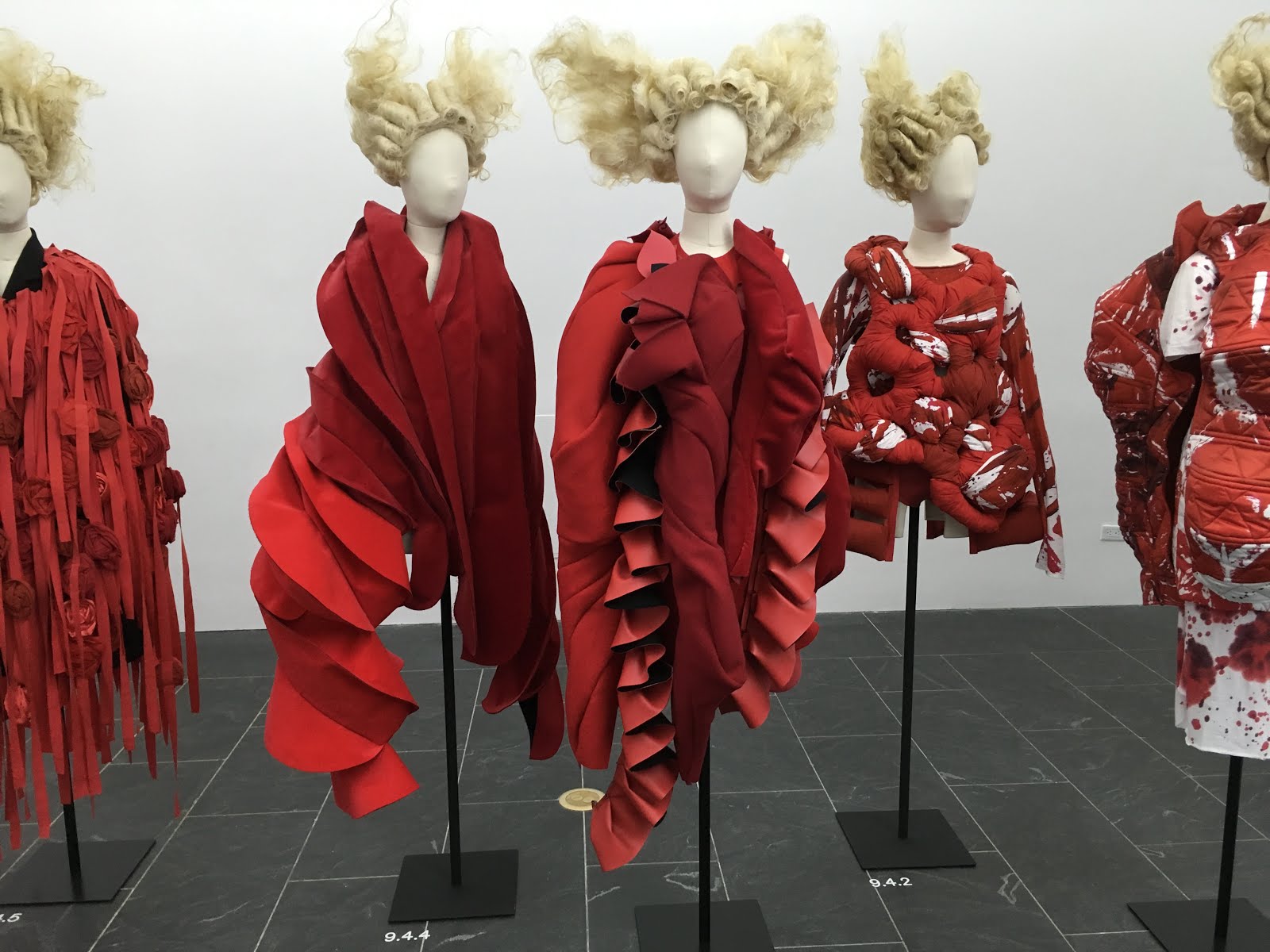
The opposite of ancient is modern...very modern...Kawakubo. Rei Kawakubo is a Tokyo-based designer known for her avant-garde designs and extremely unconventional (perhaps unwearable) clothing that challenge our notions of beauty, taste, and fashion. Since founding Comme des Garçons in 1969, Kawakubo has consistently redefined and challenged fashion and aesthetics. This spring 2017 exhibit is the Costume Institute's first exhibit dedicated to a living designer.
The Art of the In-Between features nine expressions of "in-betweenness" in Kawakubo's collections: Absence/Presence, Design/Not Design, Fashion/Antifashion, Model/Multiple, High/Low, Then/Now, Self/Other, Object/Subject, and Clothes/Not Clothes. Kawakubo's designs explore and reveal the spaces between these dualities, questioning our arbitrary definitions and offering possibilities for innovation.
But all that said, I'll still be the first to admit that I don't always understand modern art. The backdrop and explanations certainly help provide more context, and I can appreciate the intent, creativity, and art behind the designs; however, conservative, boring me had a hard time seeing the designs as wearable clothes. (Would you wear any of these??) Then again, I feel that way about a lot of runway, couture designs. I guess that's why I don't work in fashion.



 Age of Empires: Chinese Art of the Qin and Han Dynasties (221 B.C. - A.D. 220)
At The Met Fifth Avenue, April 3 - July 16, 2017
This exhibit features nearly 170 objects from ancient China, including rare ceramics, sculptures, paintings, and textiles, but perhaps the most exciting (at least to me) are the terracotta warriors. The Terracotta Army (兵馬俑) is a large collection of unique terracotta sculptures depicting the armies and palace attendants and performers of Qin Shi Huang (秦始皇), the first emperor of China. These life-sized clay sculptures were created with the intent to be buried with the emperor and to protect him in his afterlife.
The Terracotta Army was discovered in 1974 by workers digging a well outside of Xi'an and is one of the greatest archaeological discoveries in the world. The workers found thousands of clay soldiers, each with unique facial expressions and positioned according to rank, lined up in trenchlike, underground corridors. There are soldiers with different types of weaponry as well as horses and chariots -- in a nutshell, it was a replica of Qin's actual army. There are three main pits with the Terracotta Army, and in other nearby trenches, there are non-military figures, such as court officials, acrobats, and musicians. Most of the site remains unexcavated, including Qin Shi Huang's actual tomb, as workers soon discovered that the terracotta sculptures lost their color and turned gray after being exposed to the air.
The Met dedicates one room of the Age of Empires exhibit to the terracotta warriors, which include actual items from the site as well as replicas. It's not quite the same experience as being in the actual trenches in Xi'an, but this is much more geographically friendly and still quite enjoyable.


One other interesting item on exhibit is the burial ensemble of Dou Wan, who was the wife of Prince Liu Sheng of Zhongshan during the Western Han dynasty. The burial suit is comprised of small jade plaques, each shaped, fitted, and strung together with gold wire. It represents the completion of a magical transformation of a deceased's body, as the jade suit protects the body and soul, enabling the deceased to attain immortality.

Rei Kawakubo / Comme des Garçons: Art of the In-Between
At The Met Fifth Avenue, May 4 - September 4, 2017
The opposite of ancient is modern...very modern...Kawakubo. Rei Kawakubo is a Tokyo-based designer known for her avant-garde designs and extremely unconventional (perhaps unwearable) clothing that challenge our notions of beauty, taste, and fashion. Since founding Comme des Garçons in 1969, Kawakubo has consistently redefined and challenged fashion and aesthetics. This spring 2017 exhibit is the Costume Institute's first exhibit dedicated to a living designer.
The Art of the In-Between features nine expressions of "in-betweenness" in Kawakubo's collections: Absence/Presence, Design/Not Design, Fashion/Antifashion, Model/Multiple, High/Low, Then/Now, Self/Other, Object/Subject, and Clothes/Not Clothes. Kawakubo's designs explore and reveal the spaces between these dualities, questioning our arbitrary definitions and offering possibilities for innovation.
But all that said, I'll still be the first to admit that I don't always understand modern art. The backdrop and explanations certainly help provide more context, and I can appreciate the intent, creativity, and art behind the designs; however, conservative, boring me had a hard time seeing the designs as wearable clothes. (Would you wear any of these??) Then again, I feel that way about a lot of runway, couture designs. I guess that's why I don't work in fashion.