Friday, February 16, 2018

Happy Lunar New Year!

Happy Year of the Dog! 狗年吉祥!


The dog is the eleventh animal of the Chinese zodiac, and as we all know, dogs are loyal best friends, and human dogs (lol) should be too!  Trust the zodiac.  I came across this fun site on zodiac animals and thought I'd share for those interested in reading about the different personalities and characteristics of the various zodiac animals.  I certainly remember that was staple reading for me at Chinese restaurants growing up.  (Why did they all have to use the same paper placemats?)

To learn more about Chinese New Year traditions, see my CNY blog post from last year!

Wishing you all a very happy, healthy, and prosperous year filled with good fortune!

新年快樂,
萬事如意,
身體健康 ,
大吉大利!


Rice cake recipes: traditional steamed and baked

Wednesday, December 20, 2017

Noodles 101

I've been eating and posting a lot of Instagram pictures of (Asian) noodles lately, and it's certainly given me an even greater appreciation for the vast variety in existence.  Any avid noodle lover will have tried an extensive menu of noodle dishes, and if anyone else is like me, we tend to think and talk more about the dishes we like (e.g., cold sesame noodles, dan dan noodles, beef noodle soup, pho, ramen, etc.) than about the type of noodle that was used.


Given that there are so many variations of the noodle itself, I thought it would be helpful to do a brief "Noodles 101."  Not only are their different ingredients (e.g., wheat vs. rice noodles), noodles obviously also come in all shapes and sizes and can be produced a number of different ways (pulled, cut, peeled, extruded, etc.).  Each combination results in a unique flavor and textural profile that lends itself to be better enjoyed in certain types of dishes versus others.  Of course, much is also left to personal preference; I remember frequenting a Lan Zhou noodle shop in Los Angeles as a kid, and besides selecting the dish/sauce, you could also select the thickness of the noodle, which could be anything from angel hair thin to the width of a belt (that size noodle was literally named "belt" at this restaurant). 


As for me, I am a fan of fat wheat noodles because I love the chewiness.  In NYC, places that have good hand-pulled, wide noodles include Xi'an Famous Foods, Very Fresh Noodles inside Chelsea Market, and Lam Zhou Noodles.  No surprise, I also like udon more than ramen, and if a ramen joint ever offers the option to choose your noodle, I will always go with the wavy, chewy noodles over the straight, thin ones.


Anyway, below is a quick summary of some of the most common types of noodles.  The list is by no means comprehensive, but I hope it gives a good overview of the noodle landscape.  In general, northern Chinese cuisines tend to be starchier (think buns and thicker wheat noodles) while southern China has more delicate foods (e.g., soup dumplings/other thin skinned dumplings).  Southern China is also more rice heavy (think of all the rice paddies), so you'll find more rice noodles there (e.g., Yunnan mixian).


Tuesday, May 30, 2017

Dragon Boat Festival (Duanwu Festival 端午節)

Duanwu Festival (端午節), or more commonly known in English as Dragon Boat Festival, commemorates a patriotic Chinese minister name Qu Yuan (屈原).  The holiday is on the 5th day of the 5th lunar month, and the most common traditions are eating sticky rice "dumplings" called zongzi (粽子) and racing dragon boats.

Qu Yuan (340-278 B.C.) was a poet and minister who lived during the Warring States period.  He served King Huai of the Chu state (楚懷王), but was slandered by corrupt officials and exiled when he opposed King Huai's decision to ally with the increasingly powerful state of Qin (秦).  During his exile, Qu Yuan wrote some of the greatest poetry in Chinese literature, expressing his concern for his state.  Legend has it that his health deteriorated due to his anxiety, and when Qin captured Chu's capital, Qu Yuan committed suicide.

The local people greatly admired Qu Yuan and raced out in their boats to save him, but when they could not find him, they dropped balls of sticky rice into the river so that the fish would eat the rice instead of Qu Yuan's body.  That is said to be the origin of dragon boat racing and zongzi.

A quick note on zongzi because surprise, surprise, I love food -- zongzi are sticky rice with different fillings wrapped in bamboo leaves (or other leaves such as lotus, banana, reed) and then steamed.  The types of fillings vary from region to region.  For example, northern China zongzi tend to be sweet and dessert-like, while southern-style zongzi tend to be more savory.  Popular savory fillings include pork belly, salted fish, mushrooms, peanuts.  Red bean paste is a common sweet filling.  Jianshui zong (碱水粽), meaning "alkaline water zong," is a special type of dessert zongzi that is typically smaller with no filling; the sticky rice is treated with lye water or potassium carbonate to give it a distinct yellow color, and they are often enjoyed with sugar or a light syrup.

As for Dragon Boat racing, there's an annual Hong Kong Dragon Boat Festival in New  York, and the race this year takes place on August 12 and August 13, 2017 in Flushing Meadows Park.  Not sure why they don't do the race on or closer to the actual holiday, other than perhaps it's still too chilly right now.

But anyway, happy Duanwu Jie, and hope you enjoy some zongzi! 端午節快樂!

Tuesday, May 16, 2017

Current Exhibits at The Met -- the Old, the New, the In Between

The Met always has an expansive collection worth seeing, but two in particular, both currently on display, piqued my interest.  The first is "Age of Empires: Chinese Art of the Qin and Han Dynasties," and the second is "Rei Kawakubo / Comme des Garçons: Art of the In-Between."  To make our lives even easier, they are located right next to each other on the same floor (2nd floor, Tisch Galleries).

Age of Empires: Chinese Art of the Qin and Han Dynasties (221 B.C. - A.D. 220)
At The Met Fifth Avenue, April 3 - July 16, 2017

This exhibit features nearly 170 objects from ancient China, including rare ceramics, sculptures, paintings, and textiles, but perhaps the most exciting (at least to me) are the terracotta warriors.  The Terracotta Army (兵馬俑) is a large collection of unique terracotta sculptures depicting the armies and palace attendants and performers of Qin Shi Huang (秦始皇), the first emperor of China.  These life-sized clay sculptures were created with the intent to be buried with the emperor and to protect him in his afterlife.

The Terracotta Army was discovered in 1974 by workers digging a well outside of Xi'an and is one of the greatest archaeological discoveries in the world.  The workers found thousands of clay soldiers, each with unique facial expressions and positioned according to rank, lined up in trenchlike, underground corridors.  There are soldiers with different types of weaponry as well as horses and chariots -- in a nutshell, it was a replica of Qin's actual army.  There are three main pits with the Terracotta Army, and in other nearby trenches, there are non-military figures, such as court officials, acrobats, and musicians.  Most of the site remains unexcavated, including Qin Shi Huang's actual tomb, as workers soon discovered that the terracotta sculptures lost their color and turned gray after being exposed to the air.

The Met dedicates one room of the Age of Empires exhibit to the terracotta warriors, which include actual items from the site as well as replicas.  It's not quite the same experience as being in the actual trenches in Xi'an, but this is much more geographically friendly and still quite enjoyable.


One other interesting item on exhibit is the burial ensemble of Dou Wan, who was the wife of Prince Liu Sheng of Zhongshan during the Western Han dynasty.  The burial suit is comprised of small jade plaques, each shaped, fitted, and strung together with gold wire.  It represents the completion of a magical transformation of a deceased's body, as the jade suit protects the body and soul, enabling the deceased to attain immortality.


Rei Kawakubo / Comme des Garçons: Art of the In-Between
At The Met Fifth Avenue, May 4 - September 4, 2017

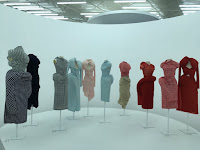
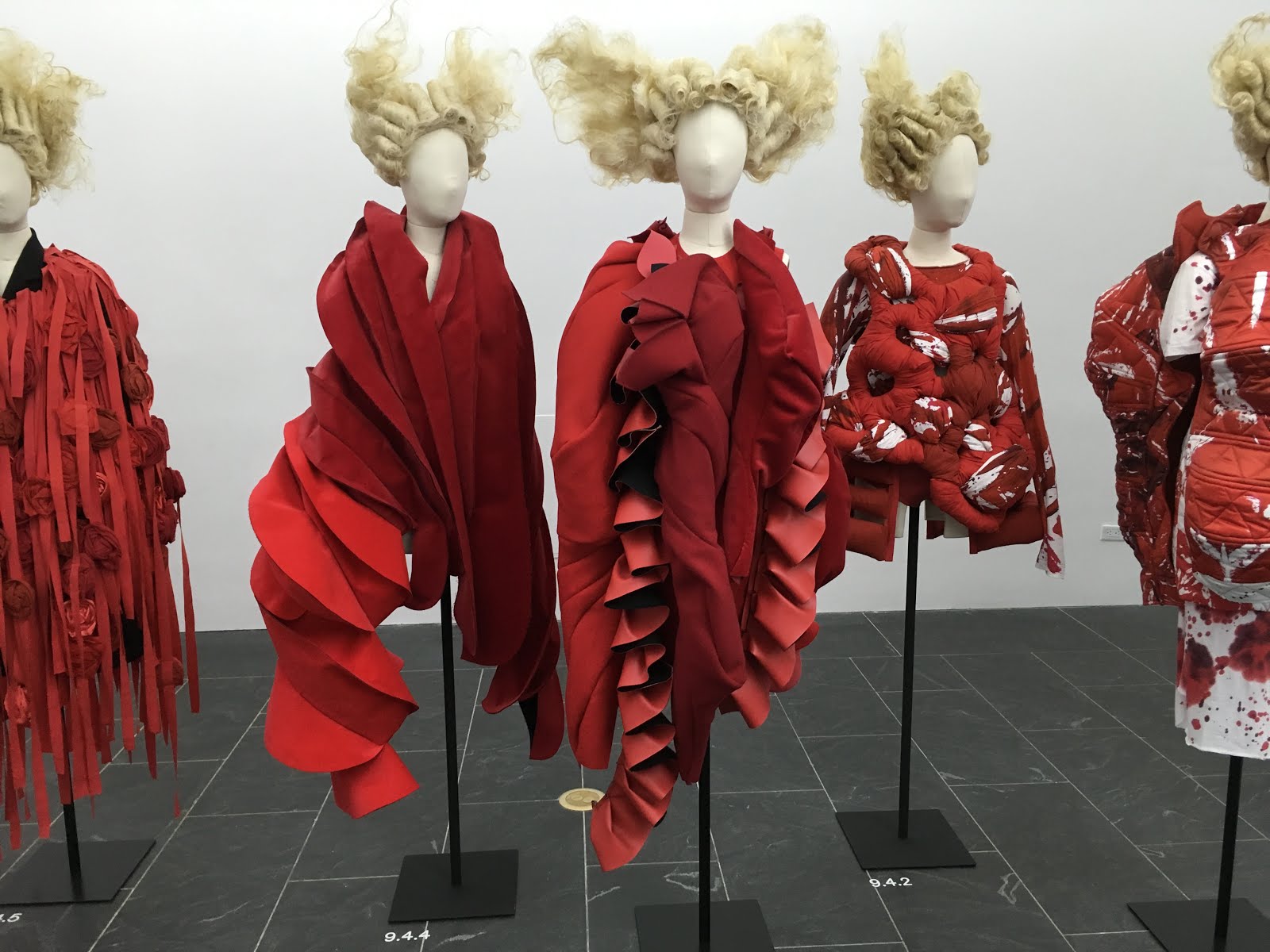
The opposite of ancient is modern...very modern...Kawakubo.  Rei Kawakubo is a Tokyo-based designer known for her avant-garde designs and extremely unconventional (perhaps unwearable) clothing that challenge our notions of beauty, taste, and fashion.  Since founding Comme des Garçons in 1969, Kawakubo has consistently redefined and challenged fashion and aesthetics.  This spring 2017 exhibit is the Costume Institute's first exhibit dedicated to a living designer.

The Art of the In-Between features nine expressions of "in-betweenness" in Kawakubo's collections: Absence/Presence, Design/Not Design, Fashion/Antifashion, Model/Multiple, High/Low, Then/Now, Self/Other, Object/Subject, and Clothes/Not Clothes.  Kawakubo's designs explore and reveal the spaces between these dualities, questioning our arbitrary definitions and offering possibilities for innovation.

But all that said, I'll still be the first to admit that I don't always understand modern art.  The backdrop and explanations certainly help provide more context, and I can appreciate the intent, creativity, and art behind the designs; however, conservative, boring me had a hard time seeing the designs as wearable clothes.  (Would you wear any of these??)  Then again, I feel that way about a lot of runway, couture designs.  I guess that's why I don't work in fashion.


Saturday, January 28, 2017

Chinese New Year

Happy Chinese (Lunar) New Year!  2017 is the year of the rooster.  CNY is a time of family gatherings and a holiday rich with traditions, but having lived away from home for so many years and residing in a country where lunar new year is not a public holiday, the holiday usually passes without much fanfare.

I was in Hong Kong last week for work, and perhaps all the decorations and overall ambiance of everyone getting ready to celebrate the new year rubbed off on me, so I decided to take yesterday off work and host my own new year's eve dinner.  Different regions (even within China) have different traditions, but here are some of the most common ones.

New Year's Eve Dinner (除夕/年夜飯):  Also referred to as the "reunion dinner," this is the most important meal and officially kicks off the festivities.

Fish is a staple, as the character for fish  (魚 yu) is a homonym for surplus (餘 yu).  The tradition is to serve a whole fish but not to finish it, leaving extra for the next year (年年有餘 nian nian you yu, meaning "to have plenty each year").

Dumplings are also common in Northern China.  The shape of the dumplings resembles traditional Chinese money (元寶 yuan bao), so it's symbolic for prosperity.  For extra fun, you can wrap new/clean coins inside the dumplings, and those that get dumplings with money will be extra lucky.  (That was fun as a kid, although now I personally question the hygiene of money inside food...)

The ruyi dish (如意菜) is made with ten different ingredients.  如意 means to fulfill one's wishes, so it's a dish with a very auspicious name.

There are many others, but I'll just note one more -- rice cakes.  The Chinese name for rice cakes (年糕 nian gao) is a homonym for high (高 gao).  The well wish to accompany your dessert is therefore 年年高升 (nian nian gao sheng), which means to rise higher each year.

Shou Sui 守歲: After the reunion dinner, everyone stays up the entire night until the new year arrives (this is called shou sui).  Legend has it that there was once a beast called 年 nian ("year"), and it would eat the villagers and cause much destruction.  Everyone used to hide in fear when the year was going to come, but then someone discovered that the beast was afraid of the color red, loud noises, and fire.  And that is why to this day, Chinese people have the tradition of wearing red, decorating their homes with red scrolls and red lanterns, and setting off fireworks at midnight.

Greetings: There's no shortage of 4-character Chinese greetings and well wishes, so here are (lucky number) eight to get started.

  1. 新年快樂 xin nian kuai le -- happy new year
  2. 萬事如意 wan shi ru yi -- may all things (lit. tens of thousands of things) go according to your wishes
  3. 心想事成 xin xiang shi cheng -- may you achieve everything your heart desires
  4. 身體健康 shen ti jian kang -- wish you good health
  5. 步步高升 bu bu gao sheng -- wish you reach new heights with each step (similar to 年年高升 nian nian gao sheng rice cake saying)
  6. 恭喜發財 gong xi fa cai -- wish you wealth and prosperity
  7. 歲歲平安 cui cui ping an -- wish you peace at every age
  8. 大吉大利 da ji da li -- wish you great luck and profit
Lantern Festival (元宵節 yuan xiao jie):  The lantern festival is the 15th and last day of the new year.  As the name suggests, lighting and viewing beautifully decorated lanterns is the main activity.  People also eat a sweet glutinous rice ball (usually a dessert soup) called 湯圓 tang yuan (or 元宵yuan xiao), which sounds similar to the phrase for reunion, 團圓 tuan yuan.  The rice balls are typically filled with a sweet filling such as black sesame, red bean, or peanut.


Other Traditions:
  • Red Envelopes (紅包): The red envelopes are filled with lucky money and are typically given by adults to children, or senior managers to employees.
  • Cleaning: Before the new year, people will clean their homes to symbolize "out with the old, in with the new."
  • Decorations: There are way too many, so I'll just highlight two.  1) You'll often see the character for good fortune 福 (fu) written on a red square and hung upside down.  That's because the character for upside down (倒 dao) sounds very similar to the character for arrived (到 dao),  so hanging 福 upside down symbolizes 福 has arrived.  2) Couplets hung on opposite sides of a door are also very common (very traditional Chinese, although you don't see it much these days except as a CNY decoration), and sometimes there's also a complementary third scroll that goes across the door top.  My mother sent around this one in English, which I thought was quite cute:

All in all, wishing everyone a very happy Year of the Rooster!


Wednesday, October 5, 2016

Chinese Calligraphy

Writing is a form of art; it's an expression of who we are, beyond the words we use.  Even in this digitized age, I can still recognize my best friends' handwriting, just like how I can recognize their voices.  I'll also bet that most of us make judgments on a person based on his or her handwriting -- bubbly "girly" handwriting or messy "doctor's" writing, to give a couple of stereotypical examples.  There's an art to typefaces as well.  The font I use for my resume is certainly different from what I chose for our wedding invitations.  Corporations pay millions of dollars to develop their branding and "visual identity" -- my former employer used to mandate Trebuchet font, and my eyes were so well trained that I actually freaked out once when one of my client presentations came out from the printing room in Arial; my OCD self almost had all the presentation books reprinted but was assured by a manager that it would only be worth the effort if it came out in Wingdings.

Beautiful writing has always drawn me in, whether it's good handwriting or a pretty typeface, whether it's English or Chinese.  Calligraphy in either language is no easy feat to master, but I recently decided to give Chinese calligraphy another go.  I had (very briefly) tried to learn Chinese calligraphy and brush painting as a child but did not have the patience at the time to make much of it, but I'm hoping this time will be different.  It first (re-)piqued my interest last fall when I was visiting my parents, and my mom was sharing the background and meaning of some of the scrolls on the living room wall (I'm sure she's done that many, many times, but I guess there's a time and place for everything, and this time it stuck with me).  It was the first time that I saw the scrolls as something more than random art and decoration; the beauty of it was not in the words alone or the calligraphy itself, but how the style of the calligraphy (and calligrapher) expresses the message.

Today, there are five major styles of calligraphy: seal script, clerical, standard (kai shu), semi-cursive, and cursive.

Chinese character for horse, from top right to left: seal script, clerical, standard, semi-cursive, cursive


Seal script (篆書, zhuan shu) was the formal script of the Qin (秦) Dynasty.  While there were other more ancient scripts, this was the first that was widely practiced.  Qin Shi Huang (秦始皇, literally translated "first emperor of Qin"), the first sovereign ruler of a unified China, had a bad rep as an extremely strict and ruthless ruler (how else does one conquer and unite all those independent kingdoms?), but he was the one who unified China economically and culturally -- he standardized Chinese units of measurements such as currency and weights, and he unified the language and Chinese script.

Clerical script is believed to have developed during the Han (漢) Dynasty.  It looks more rectangular and less hieroglyphic than seal script.

The most easily and widely recognized "standard" style today is kai shu (楷書), which developed between the Han (漢) Dynasty and Three Kingdoms period and matured in the Tang (唐) Dynasty.  It emerged from a neatly written, early period semi-cursive form of clerical script.

Semi-cursive script is also known as "running" script (行書, xing shu).  As the English name suggests, the cursive nature allows strokes between characters to run into one another, and it approximates normal handwriting with rounder, less angular characters.

Finally, the cursive script (草書, caoshu, literally translated "grass script") has a more abstract appearance.  There's more simplification of the characters, and not all characters are easily legible to the average person.

As a beginner, obviously I'm starting with kai shu standard script, roughly 3"x 3" size characters.  The larger the characters, the harder it is -- a calligrapher needs more control of a bigger brush but begins to use more of his/her arm and less of the wrist to write.  On the flip side, the smaller the characters, the harder it is too -- no margin for error yet ink bleeds!  All I can say is, I've had one class to practice three basic strokes, and I walked away with maybe one good stroke out of two pages of practice.  My teacher says having those good accidents means there's hope.  He also says he can usually tell within the first half hour which students will come back and which will quit.  I wonder which camp he thinks I'm in.


Thursday, September 15, 2016

Mid-Autumn Festival 中秋節

大家中秋節快樂!  好久沒吃到月餅了, 幸好今年剛跟爸爸媽媽見面, 他們從加州給我帶了好吃的, 我愛吃的酥皮月餅!

Happy Mid-Autumn Festival everyone!  But what exactly is Mid-Autumn Festival, why do we celebrate it, and why do we eat moon cake?

Mid-Autumn Festival falls on the 15th day of the 8th month of the lunar calendar.  Its history dates back to moon worship during the Shang Dynasty (1600-1046 BC); however, the moon worship custom did not become a festival and celebration until later in the more prosperous Sui (581 - 618 AD) and Tang (618 - 907 AD) dynasties.  A full moon is a symbol of prosperity, happiness, and reunion, hence this festival is celebrated when the moon is believed to be biggest and fullest.

The most popular legend of Mid-Autumn Festival is of Chang E, the lady on the moon.  Her husband, Hou Yi, was an excellent archer.  A long time ago, there were 10 suns, and they were scorching the Earth.  Hou Yi shot down 9 of the suns, saving the Earth and people, so the Queen Mother awarded him an elixir that could make him immortal.  However, Hou Yi wanted to stay with his wife and did not drink the elixir.  One day, one of his students tried to steal the elixir while Hou Yi was away, so Chang E drank the elixir so that it could not be stolen.  The elixir made Chang E fly higher and higher, and she did not stop until she reached the moon.  Hou Yi was saddened by the news, and prepared a table of food hoping that Chang E would return.  Since then, during the Mid-Autumn Festival, many people offered food to worship the moon.

Another more probable story is that of the Mooncake Uprising at the end of the Yuan dynasty (1271 - 1368 AD).  The Yuan dynasty was ruled by Mongols, and the ethnic Han Chinese wanted to overthrow the empire.  They hid slips of paper messages inside mooncakes and sold them to other Han Chinese as a way to communicate.  A large, successful uprising was organized on the night of the Mid-Autumn Festival, and from then on, people adopted the tradition of eating mooncakes at Mid-Autumn Festival.

Today, moon worship doesn't really take place anymore, but modern day traditions still include moon gazing, mooncake eating, and intricate lanterns/light display viewings.

As for mooncakes, we most commonly see Cantonese/Guangdong style mooncakes in stores these days, but there are other types as well.  Traditional fillings include red bean paste, lotus seed paste, jujube (date) paste, five kernels, and egg yolk.  Here are a few of the more common types:

  • Beijing style: two variations, one with a flaky, white dough and the other with a light, foamy dough; Beijing mooncakes are often more intricately decorated
  • Guangdong style: thin, cakey crust with rich, dense fillings; most popular ones you see
  • Suzhou style: known for its layers of flaky dough
Personally, I'm not a fan of the Cantonese/Guangdong style and much prefer the flaky crusts (Suzhou and Taiwan style).  My favorite fillings include red bean, dates, green bean, and taro.  Thanks to Mother Dear for bringing me my favorites all the way from California!