Saturday, June 3, 2017

Takahachi Bakery

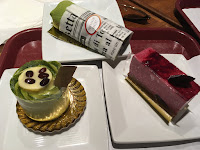
Cute and delicious Japanese bakery.  My friends and I tried 5 of the desserts: the matcha crepe roll, cassis noir mousse, Kyoto matcha mousse, truffle cake, and strawberry shortcake.  I also got a matcha latte.  Everything was good.

Matcha crepe roll -- filled with a red bean cream with just the right amount of sweetness.  It was a lot of cream, which I normally don't like, but it was light and fluffy and not overwhelming.

Cassis noir mousse -- loved the tartness of the cassis to balance the sweet.  My only nit would be the cake part at the bottom was neither cakey nor crunchy, so I was confused by the texture (flavor was good though).

Kyoto matcha mousse -- good, but not as memorable as the two above.

Truffle cake -- surprisingly good (I've come to expect not-so-good chocolate desserts at Asian bakeries, but this was good).  The cake was dense, but not dry, and the mousse part was also rich, which works for me since I like chocolate (and prefer richer, denser chocolate over airier mousses).

Strawberry shortcake -- pretty good as well.  As is often typical of Asian bakery cakes, the cake was a lighter chiffon cake.  A tad sweet for my liking, but good overall.


2nd City

Tasty Filipino fusion food.  Really flavorful comfort food overall, although not everything was perfect.

Cali Burrito -- delicious; the meats (seared pork belly and pulled chicken) were well seasoned and juicy, and the tortilla had a nice pan-fried crisp.  Only negative...where was the avocado?


Flip-n-out Burger -- this definitely reminded me of In-n-Out.  Very simple burger, but it worked well and was delicious.


Sinigang Flip Bowl -- the short rib was great, but I'm pretty sure we didn't have garlic fried rice in our bowl and instead got coconut rice.  Decent bowl, but not that standout.  The ingredients didn't seem to gel together as well as I'd hoped; nothing bad, but ingredients seemed to be very distinct as I was eating it (just felt like rice with some beef and some veggies, as opposed to a special bowl...hard to explain in words).


Tacos -- we got the bi-curious with short rib and fresh catch.  The short rib taco was the same meat as the Sinigang Flip Bowl (yum).  The fish was okay, but there are better fish tacos out there.  The chicharrones topping added a nice crunch.


Ube macapuno ice cream -- ube flavor is good but slightly on the light side, but I really liked the shredded coconut in the ice cream; it was a good combination.  Texture of the ice cream was a little bit on the harder side.


It seems there's a super duper secret menu here too.  I tried asking about some secret menu items I really wanted to try (based on pictures I've seen), but that wasn't good enough as I didn't know the exact names of the dish.  Too bad.

If I figure out some of the secret menu names, I'd definitely be interested in coming back soon to try those.

Tuesday, May 30, 2017

Breads Bakery - Cheesecake Babka

Breads Bakery makes my favorite chocolate babka (see review here), so imagine my excitement when I found out they make a special cheesecake babka in May.  I wasn't too sure how I'd like it, as I'm normally so-so on most cheesecake, but obviously I had to try it.  First sign that I would like the cheesecake babka was when I was in store, and one of the workers was handing out free samples of their cheesecake...and it was deliciously light and airy; not too dense, not too sweet.  The babka was just as good; the cheesecake filling went very well with the buttery bread (how could it not?).

That said, I still prefer the chocolate babka, as 1) it's chocolate, and 2) there are more layers, but the cheesecake babka is definitely worth trying at least once.

Dragon Boat Festival (Duanwu Festival 端午節)

Duanwu Festival (端午節), or more commonly known in English as Dragon Boat Festival, commemorates a patriotic Chinese minister name Qu Yuan (屈原).  The holiday is on the 5th day of the 5th lunar month, and the most common traditions are eating sticky rice "dumplings" called zongzi (粽子) and racing dragon boats.

Qu Yuan (340-278 B.C.) was a poet and minister who lived during the Warring States period.  He served King Huai of the Chu state (楚懷王), but was slandered by corrupt officials and exiled when he opposed King Huai's decision to ally with the increasingly powerful state of Qin (秦).  During his exile, Qu Yuan wrote some of the greatest poetry in Chinese literature, expressing his concern for his state.  Legend has it that his health deteriorated due to his anxiety, and when Qin captured Chu's capital, Qu Yuan committed suicide.

The local people greatly admired Qu Yuan and raced out in their boats to save him, but when they could not find him, they dropped balls of sticky rice into the river so that the fish would eat the rice instead of Qu Yuan's body.  That is said to be the origin of dragon boat racing and zongzi.

A quick note on zongzi because surprise, surprise, I love food -- zongzi are sticky rice with different fillings wrapped in bamboo leaves (or other leaves such as lotus, banana, reed) and then steamed.  The types of fillings vary from region to region.  For example, northern China zongzi tend to be sweet and dessert-like, while southern-style zongzi tend to be more savory.  Popular savory fillings include pork belly, salted fish, mushrooms, peanuts.  Red bean paste is a common sweet filling.  Jianshui zong (碱水粽), meaning "alkaline water zong," is a special type of dessert zongzi that is typically smaller with no filling; the sticky rice is treated with lye water or potassium carbonate to give it a distinct yellow color, and they are often enjoyed with sugar or a light syrup.

As for Dragon Boat racing, there's an annual Hong Kong Dragon Boat Festival in New  York, and the race this year takes place on August 12 and August 13, 2017 in Flushing Meadows Park.  Not sure why they don't do the race on or closer to the actual holiday, other than perhaps it's still too chilly right now.

But anyway, happy Duanwu Jie, and hope you enjoy some zongzi! 端午節快樂!

Friday, May 26, 2017

Made Nice

Made Nice is nice.  Before trying it, I was expecting it to be a pretty decent healthy option, but now that I've had it, I think it's too good to actually be healthy.

We tried the Salmon Rosti, Khao Salad, and Pork n' Carrots.  I tried really hard to think about which I liked the best, but they're all sufficiently different and all good; I'd happily order any of those again.  Note I didn't  even have these fresh; I ordered these to go in the afternoon and had them later for dinner.

Salmon rosti -- the rosti was really well done with a light crisp.  Soft boiled eggs are also always a plus.  The salad and dressing tasted light, which was a good balance to the saltiness of the smoked salmon.

Khao salad -- the beef was decently tender, and I really liked the slightly charred broccoli and the crunchiness of the broccoli and rice.  The parmesan added a nice creaminess to bring it all together.

Pork n' carrots -- the pork confit was also pretty tender and flavorful, but I was surprised on the upside by how sweet the roasted carrots were.  When I took my first bite, I could've sworn I was eating a plantain, but that's not an ingredient according to the menu.  I bet it's a trick.

I'm looking forward to coming back and trying other items on the menu.


Monday, May 22, 2017

Sushi on Jones


I think it's very good sushi at this price point (12 pieces of sushi, omakase, for $50), but I would not rank it at the top of my favorites list.

Overall most pieces of fish met baseline expectations and were reasonably fresh, but nothing too memorable.  (To be fair though, I had somewhat high expectations given the hype.)  The Hokkaido uni was very good and creamy, and I'm glad it was served twice in the omakase -- once alone, and once on top of the wagyu; we also ordered the uni-wagyu hand roll, so I had it three times, but more on that in a bit.  The scallop and bluefin tuna were also quite good.  

The wagyu was the most disappointing for me.  The quality of the meat wasn't that great, and it was stringy/too chewy.  But having had wagyu in three pieces (once alone, once with uni sushi, once with uni in hand roll), I will say it got better with each one.  Perhaps it needed to be blow torched a bit longer to make up for the quality of the meat itself.

Despite not liking the wagyu much, I felt compelled to order the uni wagyu hand roll separately anyway (costs additional $12), and while I enjoyed the roll, it was really not worth $12.  It was small, but on the plus side, I felt like the uni-wagyu flavors were more balanced in the hand roll than the other uni-wagyu sushi.


Also, I was bummed that there was no crab and we instead had oyster.  I am totally okay with replacing pieces depending on what is fresh, but oyster seemed a bit too boring.

Tuesday, May 16, 2017

Current Exhibits at The Met -- the Old, the New, the In Between

The Met always has an expansive collection worth seeing, but two in particular, both currently on display, piqued my interest.  The first is "Age of Empires: Chinese Art of the Qin and Han Dynasties," and the second is "Rei Kawakubo / Comme des Garçons: Art of the In-Between."  To make our lives even easier, they are located right next to each other on the same floor (2nd floor, Tisch Galleries).

Age of Empires: Chinese Art of the Qin and Han Dynasties (221 B.C. - A.D. 220)
At The Met Fifth Avenue, April 3 - July 16, 2017

This exhibit features nearly 170 objects from ancient China, including rare ceramics, sculptures, paintings, and textiles, but perhaps the most exciting (at least to me) are the terracotta warriors.  The Terracotta Army (兵馬俑) is a large collection of unique terracotta sculptures depicting the armies and palace attendants and performers of Qin Shi Huang (秦始皇), the first emperor of China.  These life-sized clay sculptures were created with the intent to be buried with the emperor and to protect him in his afterlife.

The Terracotta Army was discovered in 1974 by workers digging a well outside of Xi'an and is one of the greatest archaeological discoveries in the world.  The workers found thousands of clay soldiers, each with unique facial expressions and positioned according to rank, lined up in trenchlike, underground corridors.  There are soldiers with different types of weaponry as well as horses and chariots -- in a nutshell, it was a replica of Qin's actual army.  There are three main pits with the Terracotta Army, and in other nearby trenches, there are non-military figures, such as court officials, acrobats, and musicians.  Most of the site remains unexcavated, including Qin Shi Huang's actual tomb, as workers soon discovered that the terracotta sculptures lost their color and turned gray after being exposed to the air.

The Met dedicates one room of the Age of Empires exhibit to the terracotta warriors, which include actual items from the site as well as replicas.  It's not quite the same experience as being in the actual trenches in Xi'an, but this is much more geographically friendly and still quite enjoyable.


One other interesting item on exhibit is the burial ensemble of Dou Wan, who was the wife of Prince Liu Sheng of Zhongshan during the Western Han dynasty.  The burial suit is comprised of small jade plaques, each shaped, fitted, and strung together with gold wire.  It represents the completion of a magical transformation of a deceased's body, as the jade suit protects the body and soul, enabling the deceased to attain immortality.


Rei Kawakubo / Comme des Garçons: Art of the In-Between
At The Met Fifth Avenue, May 4 - September 4, 2017

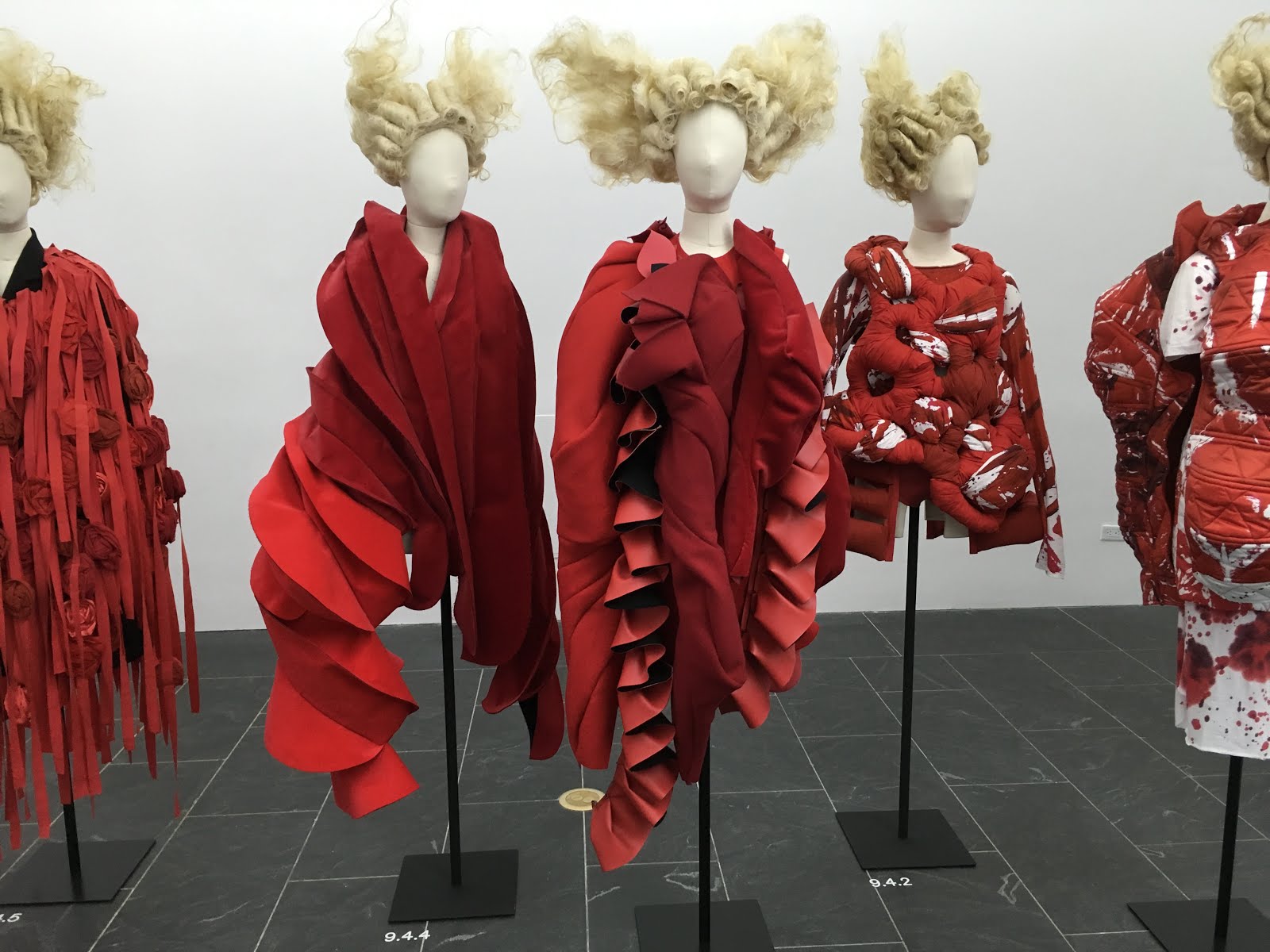
The opposite of ancient is modern...very modern...Kawakubo.  Rei Kawakubo is a Tokyo-based designer known for her avant-garde designs and extremely unconventional (perhaps unwearable) clothing that challenge our notions of beauty, taste, and fashion.  Since founding Comme des Garçons in 1969, Kawakubo has consistently redefined and challenged fashion and aesthetics.  This spring 2017 exhibit is the Costume Institute's first exhibit dedicated to a living designer.

The Art of the In-Between features nine expressions of "in-betweenness" in Kawakubo's collections: Absence/Presence, Design/Not Design, Fashion/Antifashion, Model/Multiple, High/Low, Then/Now, Self/Other, Object/Subject, and Clothes/Not Clothes.  Kawakubo's designs explore and reveal the spaces between these dualities, questioning our arbitrary definitions and offering possibilities for innovation.

But all that said, I'll still be the first to admit that I don't always understand modern art.  The backdrop and explanations certainly help provide more context, and I can appreciate the intent, creativity, and art behind the designs; however, conservative, boring me had a hard time seeing the designs as wearable clothes.  (Would you wear any of these??)  Then again, I feel that way about a lot of runway, couture designs.  I guess that's why I don't work in fashion.